The lowest pay an employer is allowed to give went up on July 1 in three places — Alaska, Oregon and Washington, D.C. — and in more than a dozen cities and counties. Together, the three states alone cover about 361,000 workers, who will share over $221 million a year in extra pay.
The new state rates
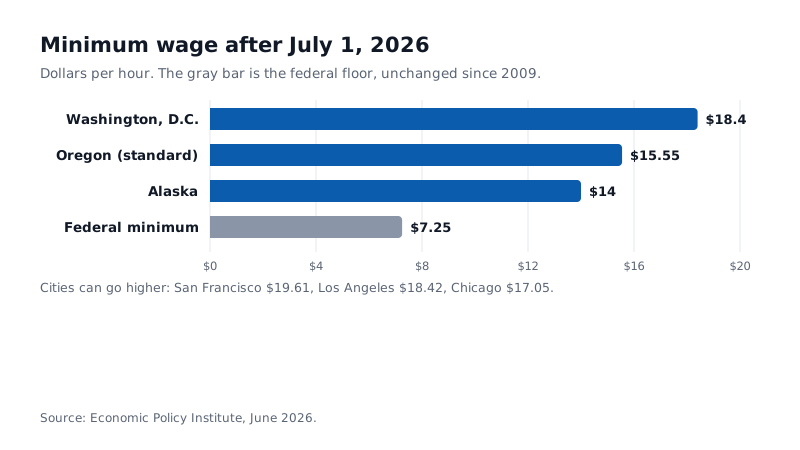
- Alaska: $14.00 an hour. About 28,300 workers get a raise.
- Oregon: $15.55 an hour standard rate. The Portland area is higher ($16.80) and rural counties are a bit lower ($14.55). About 236,900 workers are affected.
- Washington, D.C.: $18.40 an hour. About 96,700 workers.
Cities that went higher
Some cities set their own, higher minimums. From July 1: San Francisco and Berkeley pay $19.61, Los Angeles $18.42, Chicago $17.05, Cook County (around Chicago) $15.40, and Montgomery County in Maryland $18.00.
The federal minimum has not moved
The federal minimum wage is still $7.25 an hour — the same since 2009. It only applies where no higher state or city rate exists. Full time at $7.25 is about $15,080 a year. Full time at D.C.'s $18.40 is about $38,272 a year.
What this means for you
- If you work in these places for minimum wage, check your pay stubs from July on. The higher rate is the law — an employer cannot ask you to accept less.
- If your pay was already a little above the old minimum, you can point to the new floor when you ask for a raise.
- Tipped workers: rules differ by state. In some places tips can count toward the minimum; in others they cannot.
Paid by the hour? See what your rate means over a year with Hourly to Salary, Honestly.
Where these facts come from: Economic Policy Institute — July 2026 minimum wage increases. Facts checked July 2026. Numbers can change after publication.